Flat vs Gusseted Paper Bags: Which Style Works for Your Products?
Businesses often struggle to choose the right paper packaging style for their products. The difference between flat and gusseted paper bags might seem minor, but the change in structure can create a noticeable difference.
You must already be aware that a bag that smoothly packs a sub won’t be able to fit the big piece of bread loaf. The right packaging style is entirely dependent on the product you want to pack, its dimensions and customers carrying convenience.
In this article, we will explain flat vs gusseted paper bags, what features make them different and which style will suit your product the best. So without any further ado, let’s dig in!
What Are Flat Paper Bags? Usage & Benefits!
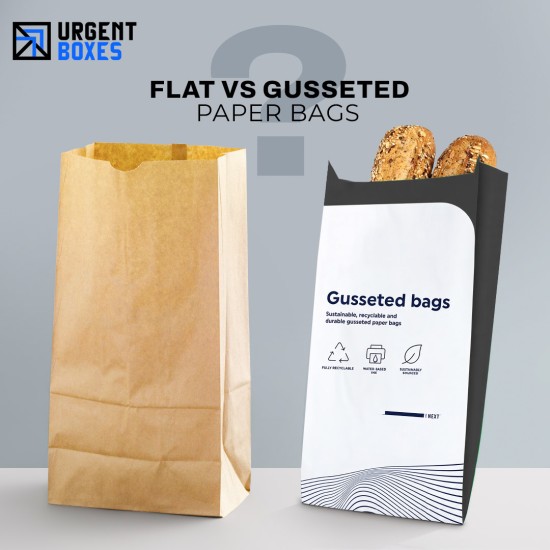
A bag that has two dimensional design and is sealed on three sides is a flat bag. Their expandable side holds give them a skin appearance. These bags are suitable for lightweight products. From food chains, pharmacies, bakeries to retail businesses, custom packaging are suitable for multipurpose usage.
Common Usage:
- Sandwiches and Subs: Suitable for wrapping individual sandwiches, classic burgers and mostly flat food.
- Cookies and Bakery Delights: Provides convenient packaging for biscuits, cookies and lightweight items.
- Documents and Supplies: Can easily pack greeting cards, photographs, envelopes and paper supplies.
- Small Retail Accessories: Work well for small retail items and compact purchases that fit in flat packaging.
Benefits:
The primary benefit of flat paper bags for packaging is their space-efficient design. They need very less storage space when stacked. This makes them convenient for businesses with limited counter space.
Their simple opening also makes them easy to fill, organize and stack. Additionally, businesses can add printed logos, brand colors and engaging graphics on these bags to create a recognizable packaging image.
What Are Gusseted Paper Bags? Usage & Benefits!
Gusseted bags are expandable, the folded side panels let the bag expand when it’s opened. These paper bags with gussets can be used for products with a higher thickness and density. You can get these bags personalized in custom sizes and dimensions according to your product requirements.
Common Usage:
- Bakery Products: You can use gusseted Kraft paper bags to pack bread loaves, bread rolls and a number baked goods.
- Diverse Food Types: These bags provide additional space for takeaway orders that come with several food sides like fries, dips and salads.
- Clothing and Retail Items: Gusseted bags can easily pack folded garments, fashion accessories and small retail purchases.
- Soap & Bath Bombs: Offers sufficient space for soap collections, bath essentials and mini gift sets.
Benefits:
The expandable side panels give these bags greater flexibility when packaging three-dimensional products. Gusseted bags create room for thicker items and allow products to sit securely inside the packaging.
These bags are also easy to fill and entertain guests during rush hours. With accurately sized bags, you can package multiple items in each bag.
Major Difference Between Flat Gusseted Paper Bags!
Their internal depth stands out to be the major difference between flat and gusseted paper bags. Unlike flat bags, gusseted bags have additional panels that can easily accommodate thicker products.
| Features |
Flat Paper Bags |
Gusseted Paper Bags |
| Structure |
No Expandable Side Folds |
Expandable Side Folds |
| Internal Space |
Limited & Fixed Depth |
Expandable Depth |
| Product Fit |
Flat Items Mostly |
Bulky and Thick Items |
| Storage |
Slim & Highly Compact |
Only Compact after Folding |
| Common Uses |
Cookies, Sandwitches, Supplies |
Apparel, Takeaway Orders, Baked Goods |
Each style is made to accommodate your products. The type of bag that you want to choose depends solely on your requirements.
Which Style Offers More Internal Capacity?
A gusseted bag will always give you more internal space than a flat bag. The additional depth of these bags allow you to pack your products with high volume and thickness. It doesn't cause compression and offers businesses great customization flexibility.
Whereas , flat bags have a sleek and slim structural construction. The capacity and internal dimensions of flat bags are strictly based on the type of product you want to package in them.
Which Style is Easier to Store & Fill?
The design of flat paper bags makes them highly suitable to store. Their simple and plain construction saves great retail space for the owners.
Gusseted bags also store flat when empty, but their folded panels add some design complexity. They might seem to take more retail space. But their expandable sides provide more room for positioning the contents, which makes them highly beneficial.
How to Choose Accurate Paper Bags Size & Dimensions!
You need to measure your products before selecting a bag style. Consider the width, height and depth, then leave some margin for adding and removing products. You need to choose dimensions based only on the front-facing measurements of your products.
How to Measure Flat Paper Bags?
Flat paper bags are generally measured by their width and height. Width refers to the front-facing measurement, while height is measured from the bottom of the bag to its top opening.
You need to measure the product's widest point and overall length to determine suitable dimensions.
How to Measure Gusseted Bags?
Gusseted paper bags are commonly specified using three measurements: width, gusset depth and height.
Width is determined by measuring the front-facing panel of the bag. Whereas, depth is determined by measuring the expandable side fold when opened. And the height is the distance from the bottom to the opening.
Factors to Consider Before You Place Your Order for Custom Packaging Boxes!
There are a few important factors that you need to consider before placing your order for custom paper bags. These factors will allow you to create custom fit and professional packaging solutions.
Materials & GSM:
Kraft and white paperboard are among the most common choices for paper bags. Brown Kraft gives your packaging a natural, rustic look, which suits grocery stores and bakeries. White paperboard has a smooth, clean surface that’s better for printing.
GSM refers to the weight of paper in grams per square metre. The right paper weight depends on the bag’s dimensions, its contents and how much it needs to carry. Some suppliers list board thickness in points (PT) instead of GSM, so see our guide on GSM vs. PT unit systems to compare the two. Always choose the material for how it needs to perform, not by GSM alone.
Styles & Handle Option:
The type of style you choose and its handle depends on your usage. The weight inside your bag will really decide the type of handles it needs.
- Twisted paper handles provide a convenient grip for retail and takeaway bags.
- For lightweight items, flat paper handles are an ideal option.
- For boutique packaging and a premium packaging experience, always go for rope handles.
- With the help of die-cut handles, you can provide a unique and aesthetic presentation to your bags.
Printing & Finishing:
Branded and custom printed paper bags will help you in making your packaging noticeable. By adding custom designs, custom finishes to these bags, you will be able to create a recognizable brand image.
Where Can Businesses Order Custom Flat Bags & Custom Gusseted Bags From?
Urgent Boxes offers you custom paper bags of all types. We create packaging that fits your branding goals, and product specifications. We offer custom sizes and shapes, kraft, paperboard, custom printing, multiple handle options, free design support and free shipping across the USA.
Whether you need custom flat bags or gusseted bags, our packaging professionals will customize them for you.